

The MTHFR Connection
Educational research summary, not medical advice. Talk with your oncologist and pharmacist before starting, stopping or changing any treatment or supplement.
The COVID pandemic caused me to rethink something I thought I already understood about folate metabolism. What I learned about MTHFR and L-methylfolate sent me back to the drawing board, wondering whether this pathway might have implications far beyond Long COVID, including neurological disease, cardiovascular disease, mental health, and even cancer.
My Growth in Understanding
About 20 years ago, I began prescribing a medical food called Metanx. One of its principal ingredients was L-methylfolate, the biologically active form of folate. Unlike ordinary folic acid, L-methylfolate does not require the MTHFR enzyme to perform the final conversion into 5-MTHF. In other words, it bypasses a potentially important "bottleneck" in folate metabolism. Growing researching proves this bottleneck is a foundational factor in many diseases.
I prescribed it frequently for several conditions because it provided a biologically active form of folate and was generally well tolerated.
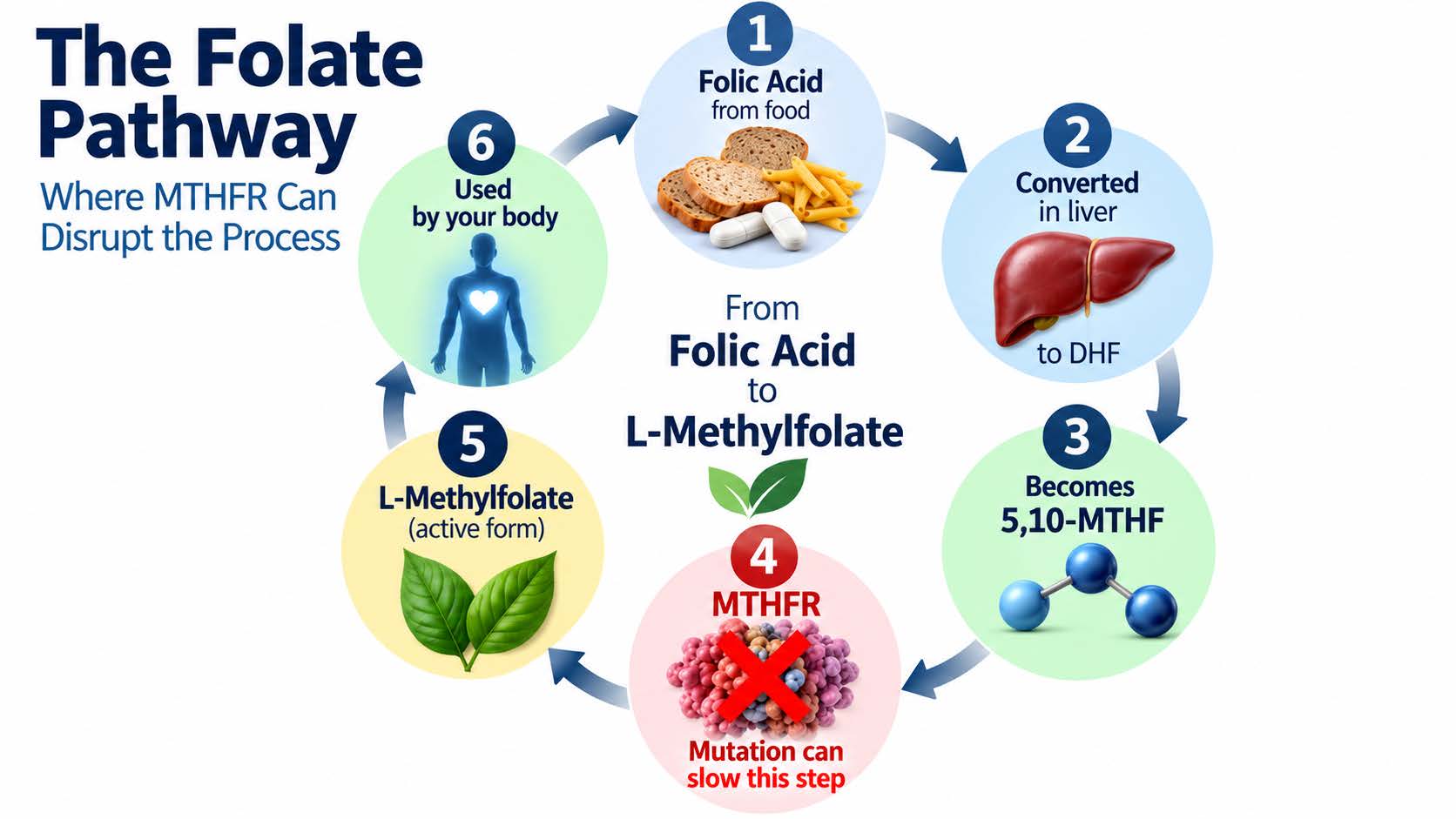
L-methylfolate bypasses the MTHFR-dependent step required to convert 5,10-methylenetetrahydrofolate into 5-MTHF. This is particularly relevant in people with MTHFR variants that reduce enzyme activity. Folate metabolism is also closely connected to homocysteine metabolism, and impaired folate metabolism can contribute to elevated homocysteine levels, which have been associated with cardiovascular disease.

Metanx was formulated for the dietary management of peripheral neuropathy, particularly diabetic peripheral neuropathy.
Deplin, available in 7.5 mg and 15 mg doses of L-methylfolate, was developed for use in patients with depression, including as an adjunct to antidepressant therapy.
Cerefolin NAC combined L-methylfolate with methylcobalamin and N-acetylcysteine for the dietary management of cognitive impairment associated with elevated homocysteine.
Rather than simply treating symptoms, I felt I was addressing a fundamental biochemical pathway. One of the things I appreciated most about L-methylfolate was how well my patients tolerated it. In my experience, I did not routinely encounter the sexual dysfunction, weight gain, nausea, fatigue, and other adverse effects that often complicated treatment with conventional antidepressants, anti-dementia meds, and neuroleptics.
The Symptoms
About 20% of the population is homozygous for the MTHFR mutation. An homozygous MTHFR mutation can be responsible for:
- Infertility, stillbirths, & miscarriages
- Chronic headaches and migraines
- Childhood behavior disorders
- Depression
- Anxiety
- Bipolar disorder
- Psychotic disorders like schizophrenia
- Allergies and sensitivities
- Gastrointestinal health and difficulty detoxifying chemicals like thimerosol and endocrine disruptors like measurable pesticides and herbicides in our food
- Insomnia
- Hormonal conditions
- Cardiovascular diseases like stroke and heart attack
- Poor healing of wounds and slow recovery of infections
- Dementia
- Colon cancer
- Leukemia
- Fibromyalgia
- Autoimmune diseases, like Hashimotos thyroiditis or lupus
- Neural tube defects in preborn children (like spina bifida and anencephaly)
It has generally been thought that people who are heterozygous for a common MTHFR variant have enough remaining enzyme activity to metabolize folate adequately and are therefore unlikely to develop symptoms attributable to the variant itself. In other words, the conventional thinking has been that one normally functioning gene is usually enough.
The Mystery
The prevailing view has been that people who are heterozygous for a common MTHFR variant usually retain enough enzyme activity that the variant, by itself, does not cause symptoms. But the fact that L-methylfolate was being studied and used in broader patient populations made me question whether the issue was really that simple.
Over time, my clinical experience led me to a different hypothesis: perhaps having one normally functioning copy of the gene is adequate under ordinary circumstances, but becomes less adequate when the body's demand for methylation increases. That question would become much more important to me years later.
The Science
There is one MTHFR gene, but there are several common variants of it. The two most widely studied are C677T and A1298C. We inherit one copy of the MTHFR gene from each parent, so a person can carry one variant copy (heterozygous), two copies of the same variant (homozygous), or one copy of each of these two variants (compound heterozygous).
Why does that matter? The MTHFR enzyme helps our bodies produce 5-MTHF, the biologically active form of folate. That process feeds into the methylation cycle, which is involved in DNA regulation, homocysteine metabolism, neurotransmitter synthesis, and numerous other cellular functions. Some MTHFR variants reduce the efficiency of this enzyme, with the degree of reduction depending upon the particular variant and whether one or two copies are inherited.
(Feel free to skip the rest of this section if the science is uninteresting to you.) The two most common MTHFR variants are C677T and A1298C. Because we inherit one copy of the MTHFR gene from each parent, these variants can occur in several different combinations.
How common are these variants? Very common. In populations of European ancestry, only about 15% of people have neither of the two common variants. Roughly 40–45% carry a single variant at either C677T or A1298C, about 20% are compound heterozygous—meaning they inherited one variant at each location—and roughly 20% are homozygous for one of the two variants.
Put another way, the great majority of people in these populations carry at least one of these common MTHFR variants. The exact percentages vary substantially with ancestry and population.
What does the MTHFR gene do? In simple terms, it helps your body convert folate from your diet into a form your cells can actually use. That active folate plays an important role in regulating genes, maintaining healthy cells, and many other functions throughout the body. L-methylfolate is already in this active form, allowing it to bypass the MTHFR step entirely.
You Can't Change Your Genes...
...But you can mitigate their effect on your health and lifespan.
We all inherit genetic variations from our parents. Some have profound consequences, while others simply alter how efficiently a particular system in the body works. Often, these differences don't cause a disease by themselves, but they can influence how our bodies respond to diet, aging, illness, medications, and other stresses.
MTHFR variants fall into this latter category. You can't change the genes you inherited, but in this case you may be able to bypass part of the problem.
L-methylfolate provides the active form of folate directly, without requiring the MTHFR enzyme to make that final conversion. That's what fascinated me about it: we can't change the gene, but we can potentially work around the metabolic bottleneck it creates.
The Controversy
As research on MTHFR and folate metabolism accumulated, I began prescribing branded L-methylfolate more frequently, particularly to patients with diabetic neuropathy, depression, or dementia, and to some patients with strong family histories of cardiovascular disease or cognitive decline. At the time, I believed that bypassing the MTHFR-dependent step might address an underlying metabolic vulnerability rather than simply treating its downstream consequences.
But not everyone approached elevated homocysteine this way. I remember working with a cardiologist who prescribed 4 mg of folic acid—ten times the usual 400 mcg daily amount—to patients with high homocysteine levels, without first testing them for MTHFR variants. His reasoning was straightforward: if impaired folate metabolism created a bottleneck, perhaps flooding the pathway with more folic acid would allow more to get through.
But I came to question that approach. Higher doses of folic acid don't bypass the MTHFR-dependent step; L-methylfolate does. And another question was beginning to emerge in the scientific literature: what happens when large amounts of folic acid remain unmetabolized in the circulation? Was it necessarily harmless?
The distinction between folic acid and L-methylfolate became important in another way. Some pharmacies substituted ordinary folic-acid products for prescriptions written for Metanx and related medical foods, a practice that eventually became the subject of class-action litigation. But these products aren't metabolically interchangeable: folic acid must travel through the folate pathway before the body can produce 5-MTHF, while L-methylfolate supplies 5-MTHF directly, bypassing the MTHFR-dependent step.
Because adequate folate during early pregnancy dramatically reduces the risk of neural-tube defects, the United States began requiring folic acid fortification of enriched grain products in the 1990s. The program was remarkably successful at reducing these devastating birth defects.
But fortification also raised another question. Unlike L-methylfolate, synthetic folic acid must be processed through several steps before it becomes the biologically active. When folic acid intake exceeds the body's capacity to process it, some can remain in the circulation as unmetabolized folic acid. Researchers have been studying whether chronically elevated levels of unmetabolized folic acid have health consequences.
The prevailing view has been that people who are heterozygous for a common MTHFR variant retain enough enzyme activity that the variant alone is unlikely to cause symptoms. My clinical experience led me to wonder whether that remains true under every circumstance. What if one normally functioning copy is adequate during ordinary life, but becomes less adequate during severe illness, prolonged physiological stress, or other conditions that place greater demands on these metabolic pathways?
That question took on an entirely new significance for me during the COVID pandemic.
Vaccine Injury and Long Haul COVID
During the opening months of the pandemic, I served as a night-shift supervisor at a 200-bed FEMA field hospital in the Georgia World Congress Center in downtown Atlanta. When I wasn't working, I studied the COVID pathogen and the rapidly evolving research surrounding it. Later, I treated thousands of patients from around the country with acute COVID-19 and persistent symptoms, and I also evaluated patients suffering after their COVID vaccination.
Like many physicians working during those early years, I followed emerging research and experimented with treatment approaches endorsed bv the Frontline COVID-19 Critical Care Alliance. That experience eventually brought me back to a question I had been thinking about for years: could differences in folate metabolism help explain why some patients recovered quickly while others struggled with persistent symptoms?
But the more I learned about the neurological effects of SARS-CoV-2, the more interested I became in why patients responded so differently to the same biological stress. COVID could affect far more than the respiratory tract. Patients were reporting brain fog, loss of taste and smell, fatigue, palpitations, hormonal disturbances, and other symptoms involving multiple organ systems. Researchers were uncovering complex effects involving inflammation, the immune system, blood vessels, coagulation, and the nervous system.
Yet the question that fascinated me was more basic: why could one person encounter COVID and recover uneventfully, while another developed persistent, debilitating symptoms?
My First Time
The first time I prescribed Metanx to a patient suffering with persistent symptoms after COVID, she was a woman in her 50s who had been struggling for ten months. Her acute infection had lasted about two weeks, but afterward she was left with persistent chest pain, numbness and tingling in her fingers, brain fog, stomach pain and bloating, and frequent episodes of rapid heart rate.
By the time I met her, she had undergone extensive evaluation. A cardiologist had performed a stress test and treated her palpitations with a beta blocker. She had seen a gastroenterologist for chronic bloating and abdominal symptoms and a neurologist for her headaches, numbness, loss of taste and smell, and brain fog. Despite months of specialist visits, testing, medications, and procedures, she remained significantly impaired. She was depressed by how dramatically her health had changed and was considering disability and early retirement.
Desperate, she ordered a consult with me. Of course, I prescribed the Frontline-recommended medications and supplements, but for the first time, I tried Metanx. After all, it had an indication for peripheral neuropathy, and that was one of her main symptoms. What if her constellation of miseries was all neurologically-mediated? Her palpitations, depression, gastrointestinal bloating, her headaches and numbness and brain fog? Her persistent loss of taste and smell? COVID-19 was new and there was still so much we didn't know about it.
Two weeks later, she contacted me with remarkable news: she was "95% better!" After ten months of persistent symptoms, she reported a dramatic improvement within two weeks.
Was L-methylfolate responsible? She started several treatments at the same time, there was no control group, and one patient's experience cannot establish cause and effect. But the magnitude and timing of her improvement caught my attention. After months of suffering, she told me, “You have given me my life back! I'm getting off disability and going back to work.”
The Strange Dichotomy
My brother got a COVID vaccine and has been handicapped from it ever since, with crippling difficult-to-treat rheumatoid arthritis. My wife's died in her sleep the night after her COVID vaccine. A dear friend who was a pastor in Colorado died suddenly after concocting COVID.
Increasingly, as the pandemic unfolded, I was struck by how differently people responded to both COVID infection and vaccination. I saw people who recovered quickly and others who developed persistent symptoms that changed their lives, or they lost their lives.
Why did some people develop severe or persistent symptoms or died, while others experienced relatively mild disease—or no symptoms at all? Age, underlying health, immune function, genetics, other meds and supplements, and many other factors clearly played a role. But I began to wonder whether folate metabolism might be one additional piece of the puzzle.
Could common MTHFR variants, and the differences in enzyme activity they produce, influence how some people responded to the extraordinary physiological stress of COVID-19 or the COVID vaccine?
That question brought me back to MTHFR.
Could MTHFR Status Be a Factor?
At the time, very little had been published about MTHFR and COVID. I contacted the FLCCC and asked them to consider adding L-methylfolate to their list of recommendations, but the evidence simply wasn't there yet. Then studies began to appear.
In 2021, researchers reported a correlation between the worldwide prevalence of the MTHFR C677T variant and COVID-19 incidence and mortality. One article demonstrating a connection concluded, "There is a clear trend toward the worldwide prevalence of MTHFR 677T and COVID-19 incidence and mortality." The FLCCC began to publish data on it. Since then, patient-level research has added to the evidence. More recent investigators studying COVID patients found that abnormalities in folate metabolism were associated with disease severity, and patients homozygous for the MTHFR C677T variant had a higher incidence of severe disease.
Of course, MTHFR could never explain everything. COVID outcomes are influenced by age, underlying disease, immune function, genetics, nutrition, and many other factors. But I began to wonder whether reduced MTHFR activity might become more important when the body is under extraordinary physiological stress.
Imagine a small town with a lumberyard that easily supplies enough building materials for everyday repairs. Then a hurricane hits. Suddenly, the same lumberyard that was perfectly adequate yesterday can't keep up with the enormous demand for rebuilding materials.
Perhaps folate metabolism works similarly. A person with reduced MTHFR activity may have more than enough capacity under ordinary circumstances. But during severe illness, inflammation, or other major physiological stresses, demands on folate metabolism may change. Could a pathway that was adequate before illness become a limiting factor during recovery?
L-methylfolate intrigued me because it doesn't require us to push more material through that particular MTHFR-dependent step. It supplies 5-MTHF directly, effectively delivering some of the “building materials” downstream of the bottleneck.
Could the MTHFR Status Affect Vaccine Adverse Events
This raised another question for me: could MTHFR status help explain why some people experience significant adverse events following vaccination while most do not?
The thimerosal or aluminum adjuvant in vaccines, for example, require detoxification in the body. Given how important the MTHFR pathways are to detoxification, perhaps MTHFR status holds the key to why some have such severe side effects from vaccines that others tolerate reasonably well. One researcher estimated, "If you have one MTHFR C677T mutation, your ability to detoxify mercury is decreased by 50%. If you have two MTHFR gene mutations at C677T, your ability to detoxify the mercury is decreased by a whopping 90%"

Years before COVID, researchers studying smallpox vaccination found that certain MTHFR variants were associated with a greater risk of adverse events in two independent groups of vaccine recipients. More recently, researchers have specifically investigated MTHFR variants and adverse events following COVID-19 vaccination.
More recently, several case reports have described serious thrombotic events following COVID-19 vaccination in patients with MTHFR variants, prompting researchers to ask whether there might be an association.
So this remains a reasonable question, not an answer. But given how common MTHFR variants are, I believe it is a question worth investigating.
What the Evidence Means for You
We know that MTHFR variants are extraordinarily common. We know these variants negatively impact folate metabolism, which is intimately connected with heart disease risk, immune responses, detoxification pathways, and is a precursor to serotonin, hormones, and many other things critical for optimal health.
The newer research has made the story more promising for L-methylfolate. Studies have reported associations between MTHFR variants and vaccine adverse events and COVID-19 severity. Patient-level research has found greater COVID disease severity among those with MTHFR variants.
Then there is my own clinical experience. I watched patients with prolonged, debilitating post-COVID symptoms improve after treatment regimens that included L-methylfolate, sometimes dramatically.
I don't believe the evidence justifies dismissing heterozygous MTHFR variants as irrelevant, nor does it justify claiming that MTHFR alone explains Long Haul COVID or vaccine adverse events. MTHFR status may just be one of many genetic and metabolic factors that influence how an individual responds when the body is placed under extraordinary physiological stress. That possibility deserves much better research.
We cannot change the MTHFR genes we inherited. But we already have a well-studied, biologically active form of folate that bypasses this enzymatic step. Whether taking L-methylfolate can meaningfully improve your health is an easy, inexpensive question to answer, given it's over-the-counter status. Most supplement companies provide far too little for significantly-affected patients, but doses as high as 15 mg are now commercially available over-the-counter.